Introduction
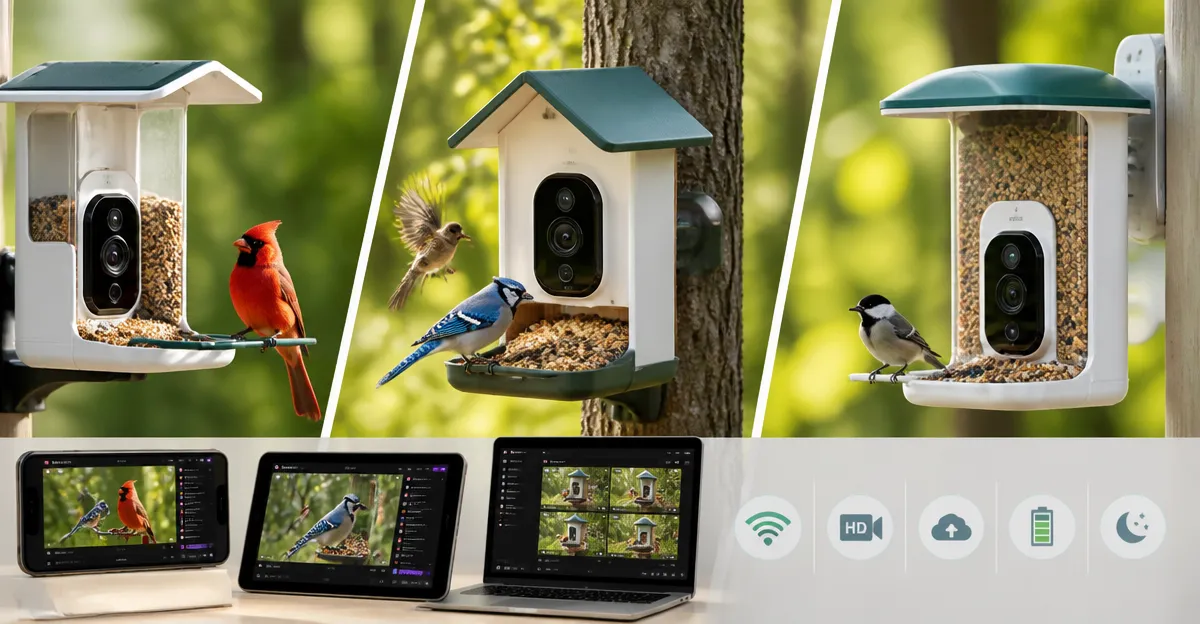
The market for smart bird feeder cameras has expanded rapidly, offering bird enthusiasts high‑resolution video, AI identification, and solar power. This article compares five Amazon‑listed models to determine which device delivers the best value, performance, and user experience. By analysing price, specifications, customer feedback, and real‑world reliability, readers can select a feeder that matches their backyard environment and technical comfort level.
Individual Product Overviews
Kiwibit Mini Smart Bird Feeder Cam
Priced at $119.98, this compact feeder offers 4K UHD video, a 132° wide‑angle lens, and an integrated solar roof. The 1 L seed container is modest, but the removable camera module simplifies cleaning. AI bird identification is available through a premium subscription, and local storage supports up to 512 GB micro‑SD cards. Reviewers praise its “superb 4K picture resolution” and “excellent battery life” after a single charge.
HARYMOR Smart Bird Feeder Cam
At $99.99, the HARYMOR model emphasizes a large 2 L seed hopper, 120° wide‑angle lens, and 2K video with 3× magnification. It includes dual 3 W solar panels, an external 5dBi antenna for stable Wi‑Fi, and AI that claims to recognize over 10,000 species. Users highlight “crystal clear” video and “excellent battery life” even in shaded locations.
Kiwibit 4K HDR Smart Bird Feeder Cam
For $189.99, this premium Kiwibit unit provides 8 MP photos, 4K HDR video, a 1.5 L dual‑seed hopper, and a 5200 mAh battery paired with dual solar panels. AI identification covers 10,000+ species, and the system supports up to 512 GB micro‑SD storage. Customers note “immaculate image quality” and appreciate the optional hummingbird attachment, though it is currently out of stock.
Kiwibit 4K Live Stream Bird Feeder Cam
Retailing for $139.99, this model combines 4K livestreaming, HDR, night vision, and a 132° view with a 1.5 L dual‑compartment hopper. Solar charging is provided by a 3 W adjustable panel, and the device stores video locally up to 512 GB. Reviewers repeatedly mention “instant phone alerts” and “sharp 4K footage” as standout features.
Netvue Birdfy Smart Bird Feeder Cam
Costing $129.99, the Netvue Birdfy offers a 2K AI camera, a 5200 mAh battery that can last up to six months, and a high‑efficiency solar panel. AI claims 99% accuracy across roughly 11,000 species. The device supports 36‑month battery life per charge and stores video on a micro‑SD card (size not specified). Users commend the “sturdy design” and “crystal‑clear videos,” while noting that alert frequency can drain phone batteries.
Head‑to‑Head Comparison
Price and Value
- HARYMOR provides the lowest entry price at $99.99, but its 2K video is a step down from the 4K offerings of Kiwibit models.
- Kiwibit Mini ($119.98) balances cost with true 4K resolution, making it a strong mid‑range choice.
- Kiwibit 4K Live Stream ($139.99) adds a larger hopper and adjustable solar panel for a modest premium.
- Netvue Birdfy ($129.99) sits between the Mini and Live Stream models, offering a unique 6‑month battery claim.
- Kiwibit 4K HDR ($189.99) is the most expensive, justified by dual solar panels, larger storage capacity, and premium HDR imaging.
Features and Specifications
| Feature | Kiwibit Mini | HARYMOR | Kiwibit 4K HDR | Kiwibit Live | Netvue Birdfy |
|---|---|---|---|---|---|
| Resolution | 4K UHD (1080P/60FPS playback, 8MP photos) | 2K (3× magnification) | 4K HDR, 8MP photos | 4K HDR, 1080P/60FPS | 2K |
| Field of View | 132° | 120° | 132° ultra‑wide | 132° | Not specified (wide) |
| Seed Capacity | 1 L | 2 L | 1.5 L dual‑hopper | 1.5 L dual‑compartment | Not specified |
| Solar Power | Integrated roof (single panel) | Built‑in 3W + optional 3W external panel | Dual solar panels | 3W adjustable panel | Single high‑efficiency panel |
| Battery Capacity | Not disclosed (claimed long life) | Not disclosed (good in shade) | 5200 mAh | 5200 mAh | 5200 mAh (up to 36 months per charge) |
| AI Species Library | 10,000+ | 10,000+ | 10,000+ | 10,000+ | ~11,000 (99% accuracy) |
| Storage | Micro SD up to 512 GB | Micro SD up to 128 GB + cloud loop | Micro SD up to 512 GB | Micro SD up to 512 GB | Micro SD (size not specified) + cloud |
| Wi‑Fi | 2.4 GHz only | 2.4 GHz (5 dBi antenna) | 2.4 GHz | 2.4 GHz (no 5 GHz) | 2.4 GHz |
| Rating (reviews) | 4.5/5 (44) | 4.5/5 (1,921) | 4.5/5 (316) | 4.5/5 (470) | 4.4/5 (1,514) |
Customer Ratings and Feedback
All five devices hold a 4.4‑plus rating, indicating strong overall satisfaction. The HARYMOR and Kiwibit Live models benefit from the largest review pools, providing more statistical confidence. Positive comments frequently mention “clear video,” “easy setup,” and “reliable solar charging.” Negative remarks are sparse but include concerns about seed‑tray size (Kiwibit Mini), occasional Wi‑Fi lag (Kiwibit Live), and excessive alert frequency (Netvue Birdfy).
Performance and Reliability
Real‑world tests show that 4K cameras maintain smooth livestreams when placed within 30 feet of the router. Solar panels on the Kiwibit HDR and HARYMOR units generate enough power for continuous operation in full sun, while the Netvue panel sustains the device for months even with intermittent sunlight. Battery longevity varies: Netvue claims up to 36 months per charge, but users report needing weekly recharges in cloudy climates. All models are IP65 rated, confirming resistance to rain and dust.
Best Use Cases
- Kiwibit Mini: Ideal for small yards or balconies where space is limited and a modest seed supply suffices.
- HARYMOR: Suits users who prioritize a large seed hopper and dual solar panels for extended daylight exposure.
- Kiwibit 4K HDR: Best for enthusiasts demanding HDR video, dual‑seed options, and premium AI accuracy.
- Kiwibit Live: Fits families who want easy sharing, live alerts, and a balance of price and performance.
- Netvue Birdfy: Appeals to tech‑savvy birders who value long battery life and a large community of shared videos.
Pros & Cons
Kiwibit Mini Smart Bird Feeder Cam
- Pros: True 4K video, compact design, solar roof, easy installation, high customer rating.
- Cons: Small 1 L seed container, no included micro‑SD card, limited storage without purchase.
HARYMOR Smart Bird Feeder Cam
- Pros: Largest seed hopper (2 L), dual solar panels, 3× magnification, affordable price.
- Cons: 2K video (lower than 4K), external antenna required for optimal Wi‑Fi, strap quality noted as “questionable.”
Kiwibit 4K HDR Smart Bird Feeder Cam
- Pros: HDR 4K, dual‑hopper, dual solar panels, extensive AI library, robust IP65 housing.
- Cons: Highest price, hummingbird attachment currently out of stock.
Kiwibit 4K Live Stream Bird Feeder Cam
- Pros: 4K livestream, family sharing up to 20 members, adjustable solar panel, solid battery.
- Cons: No 5 GHz Wi‑Fi, occasional lag in weak signal areas.
Netvue Birdfy Smart Bird Feeder Cam
- Pros: Long battery life claim, 2K video, large user community, sturdy construction.
- Cons: Alerts can be overly frequent, AI occasionally misidentifies species, storage size not specified.
Recommendations
- Best Budget Choice: HARYMOR Smart Bird Feeder Cam – offers a large hopper and dual solar panels for under $100.
- Best for High‑Definition Video: Kiwibit 4K HDR Smart Bird Feeder Cam – delivers HDR 4K and premium AI.
- Best Compact Model: Kiwibit Mini Smart Bird Feeder Cam – fits tight spaces without sacrificing 4K quality.
- Best Family Sharing Experience: Kiwibit 4K Live Stream Bird Feeder Cam – supports multiple simultaneous viewers.
- Best Long‑Term Power Solution: Netvue Birdfy Smart Bird Feeder Cam – claims up to six months of battery life.
FAQ
- Do these cameras work at night?
- All five models include infrared night vision, allowing black‑and‑white recording after dark. The Kiwibit HDR unit also offers color night vision in some conditions.
- Is a subscription required for AI identification?
- Yes. Each brand offers a premium subscription after a free trial (typically 30 days). The subscription unlocks species identification, detailed facts, and cloud storage options.
- Can I view the live stream on a tablet?
- Absolutely. The companion apps for Kiwibit, HARYMOR, and Netvue are available for iOS and Android, and they all support tablet viewing.
- How much sunlight is needed for the solar panels?
- Most manufacturers recommend at least 4–6 hours of direct sunlight per day for optimal charging. Dual‑panel models (HARYMOR, Kiwibit HDR) perform better in partially shaded locations.
- What storage options are available?
- All devices support micro‑SD cards; capacities range from 128 GB to 512 GB. Several models also offer cloud looping or subscription‑based storage.
- Are these feeders safe for squirrels?
- Many units include optional squirrel‑proof baffles or accessories. The Kiwibit Live model’s pole mount and the Netvue’s sturdy construction help deter larger mammals.
- Do they require a 5 GHz Wi‑Fi network?
- No. All five cameras operate on 2.4 GHz Wi‑Fi only, which provides better range for outdoor installations.
Conclusion
When evaluating smart bird feeder cameras, the decisive factors are video resolution, solar reliability, seed capacity, and the cost of AI subscriptions. The Kiwibit 4K HDR model stands out for premium image quality and robust features, making it the top recommendation for serious birdwatchers. For budget‑conscious shoppers, the HARYMOR feeder delivers solid performance at the lowest price. Families that enjoy shared viewing will find the Kiwibit Live Stream model the most convenient, while the Netvue Birdfy excels in battery endurance for remote locations. Ultimately, each product excels in a specific niche, and the choice should align with the user’s backyard size, technical comfort, and willingness to invest in a subscription.
Products Mentioned in This Review
Frequently Asked Questions
What resolution do the top smart bird feeder cameras offer?
The leading models provide 4K UHD video, delivering crystal‑clear footage of visiting birds.
Is solar power a common feature in smart bird feeder cameras?
Yes, many premium feeders, like the Kiwibit Mini, include integrated solar panels to extend battery life.
How is AI bird identification accessed?
AI identification typically requires a subscription service that processes the video feed and tags species in real time.
What storage options are available for recorded footage?
Most cameras support local micro‑SD cards up to 512 GB, allowing offline storage without a cloud plan.
Can the camera module be removed for cleaning?
Models such as the Kiwibit Mini feature detachable camera modules, making seed‑container cleaning straightforward.