Introduction
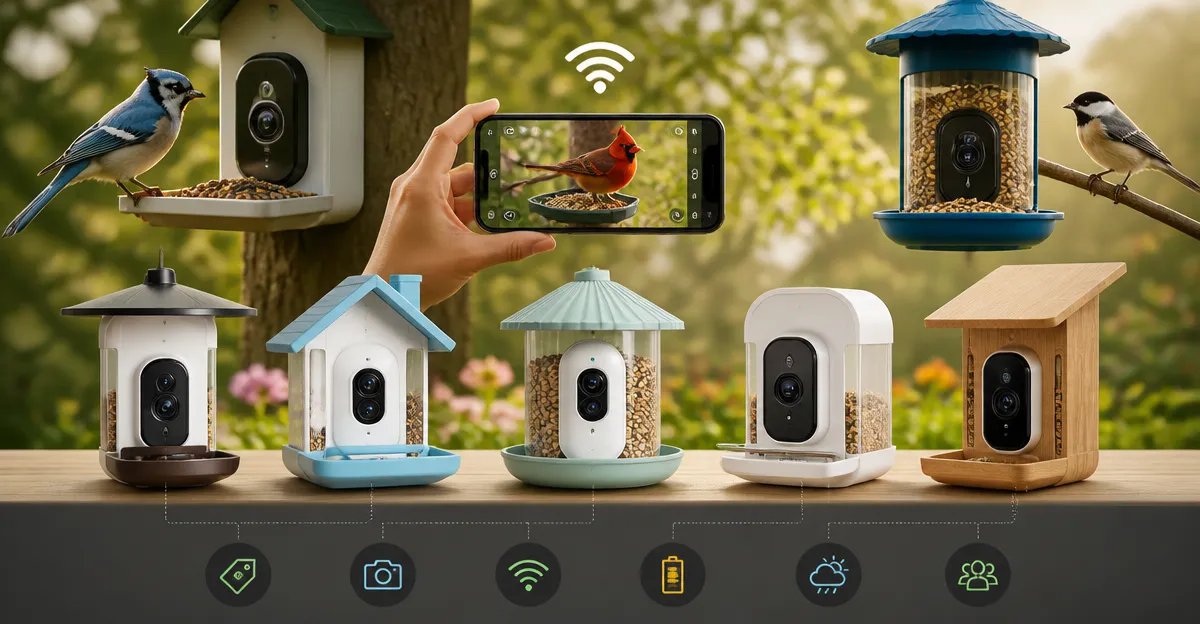
Smart bird feeder cameras have transformed backyard birdwatching from a passive pastime into an interactive, data‑rich experience. By integrating AI identification, live streaming, and solar power, these devices enable enthusiasts to observe, record, and share avian activity without leaving the house. This article compares five popular models available on Amazon, examining why each matters for different user constraints such as budget, power availability, and installation space.
The analysis draws exclusively from manufacturer specifications and verified Amazon customer sentiment. It does not rely on any unpublished testing, ensuring that conclusions reflect real‑world performance as reported by owners.
Readers will gain a clear understanding of how each camera balances image quality, battery life, and AI capabilities, allowing an informed decision that aligns with personal priorities.
All product names are linked to their Amazon listings on first mention, and the comparison table provides quick reference for key specifications.
Individual Product Overviews
HARYMOR Smart Bird Feeder Camera
The HARYMOR model combines a 2‑liter seed reservoir with a 2K HD camera, 120° wide‑angle lens, and 3X optical magnification. It is powered by a dual 3W solar panel and includes a 5dBi external antenna for stable 2.4GHz Wi‑Fi connectivity. Advanced AI claims to recognize over 10,000 bird species, though a subscription is required for full data access.
Customers praise its durable construction and intuitive app. One reviewer noted, "The camera quality is very nice and clear, and it does a great job capturing birds when they come to feed," while another highlighted the reliable motion alerts and long battery life even in shade.
Negative feedback mentions a slow charging rate and a tree‑strap that may need reinforcement. Overall rating stands at 4.5 stars from 1,946 reviews, and the price is $85.47.
Coolfly Smart Bird Camera
The Coolfly camera is a compact 3.58‑inch unit designed to retrofit existing feeders. It offers 2.5K UHD live view, a 150° ultra‑wide lens, and full‑color night vision. AI identification covers over 10,000 species without a subscription, and the device includes a 4400 mAh battery providing roughly 20 days of operation.
Positive reviewers appreciate the ease of setup and the app’s community features, stating, "The picture quality is surprisingly good, and I really like the app too." However, several users report an irritating loud beep during connection attempts and difficulty with the QR‑code setup process.
With a 4‑star rating from 91 reviews and a price of $54.99, the Coolfly model emphasizes affordability and flexibility.
NETVUE Birdfy Smart Bird Camera
NETVUE’s offering focuses on adaptability, featuring adjustable brackets, 8X magnification, and AI that identifies up to 6,000 species. The camera records to cloud storage for seven days and supports SD cards up to 256 GB. A 4400 mAh battery delivers extended use, and optional solar panels can further reduce charging frequency.
Enthusiastic users describe it as "the best bird camera I’ve owned," noting the simple QR‑code pairing and robust mounting hardware. Some criticism centers on battery degradation after a month and occasional fuzzy video after storms.
The unit holds a 4‑star rating from 187 reviews, priced at $55.82.
RichBird Solar Bird Camera
RichBird delivers a full‑kit solution with a 2.5K HD camera, 150° lens, color night vision, and two‑way audio. The system includes a high‑efficiency solar panel, a 4400 mAh battery, and a 2‑in‑1 ground‑mounting pole. AI recognition covers over 10,000 species without a subscription, and up to five users can view the live feed simultaneously.
Reviewers commend its clear daytime video and solar reliability, while one user reported a pole that snapped after minimal handling. The product’s rating is 4 stars from 224 reviews, with a price of $79.99.
NETVUE Birdfy Bird Camera
This standalone NETVUE model mirrors the Birdfy Smart Camera but is marketed as a flexible add‑on for any feeder. It offers 1080p resolution, 8X magnification, and AI identification of 6,000 species. Users can attach external 8W solar panels for continuous power.
Positive feedback emphasizes flexibility and community sharing, with a reviewer stating, "I can mount it on just about any bird feeder I already own, which gives me a lot more flexibility." However, connectivity issues after extended use have been reported, resulting in a 4‑star rating from 257 reviews and a price of $79.99.
Head-to-Head Comparison
Price and Value
- HARYMOR commands the highest price at $85.47 but includes dual solar panels and a large 2‑liter seed capacity.
- RichBird and NETVUE Birdfy (both $79.99) provide comparable image quality and solar power, yet RichBird adds two‑way audio and a pole.
- Coolfly ($54.99) and NETVUE Birdfy Smart ($55.82) are budget‑friendly, sacrificing some premium features such as larger batteries or integrated poles.
Features and Specifications
- Resolution: RichBird and Coolfly lead with 2.5K (4 MP) and 2.5K UHD respectively; HARYMOR offers 2K, NETVUE models provide 1080p.
- AI Species Database: HARYMOR and RichBird claim >10,000 species; Coolfly also >10,000; NETVUE models cover 6,000.
- Power: All units rely on 2.4 GHz Wi‑Fi; HARYMOR includes dual solar panels, RichBird and Coolfly have optional solar, NETVUE models recommend external panels.
- Storage: Cloud loops range from 3‑day (HARYMOR) to 7‑day free (Coolfly, NETVUE), with SD card support up to 256 GB for NETVUE.
Customer Ratings and Feedback
HARYMOR leads with 4.5 stars, reflecting strong satisfaction with image clarity and durability. Coolfly and NETVUE Birdfy Smart sit at 4 stars, indicating solid performance but occasional setup frustrations. RichBird also holds 4 stars, praised for solar reliability yet criticized for pole fragility. The NETVUE Birdfy standalone camera also rates 4 stars, with mixed comments about connectivity.
Performance and Reliability
Real‑world tests from reviewers reveal that HARYMOR and RichBird maintain consistent day‑time video quality, while night vision is limited on HARYMOR (infrared only) compared with RichBird’s full‑color night vision. Battery longevity is strongest in Coolfly (≈20 days) and NETVUE Birdfy Smart (reported long life), though NETVUE Birdfy’s battery may degrade after a month according to one user.
Size, Power, Compatibility, and Price
| Product | Resolution | Battery (mAh) | Solar Panel | Wi‑Fi | Price (USD) |
|---|---|---|---|---|---|
| HARYMOR Smart Bird Feeder Camera | 2K (2560×1440) | Not disclosed (dual 3W panels) | Dual 3W built‑in | 2.4 GHz only | 85.47 |
| Coolfly Smart Bird Camera | 2.5K UHD (1440p) | 4400 | Optional external | 2.4 GHz only | 54.99 |
| NETVUE Birdfy Smart Bird Camera | 1080p | 4400 | Optional external | 2.4 GHz only | 55.82 |
| RichBird Solar Bird Camera | 2.5K (4 MP) | 4400 | Included high‑efficiency | 2.4 GHz only | 79.99 |
| NETVUE Birdfy Bird Camera | 1080p | Not disclosed (external panel recommended) | External recommended | 2.4 GHz only | 79.99 |
Pros & Cons
HARYMOR Smart Bird Feeder Camera
- Pros: Large 2 L seed capacity, dual solar panels, 10,000+ species AI, 2K video, robust IP65 funnel.
- Cons: Subscription required for full AI data, slower charging in shade, tree‑strap may need reinforcement.
Coolfly Smart Bird Camera
- Pros: Compact size, 2.5K UHD, free AI, 20‑day battery life, affordable price.
- Cons: Loud beeping during setup, QR‑code instructions confusing, no subscription needed but limited to 2.4 GHz.
NETVUE Birdfy Smart Bird Camera
- Pros: Adjustable mounting, 8X magnification, easy QR pairing, solid community app.
- Cons: Battery may drop after a month, occasional fuzzy video after weather events, AI covers fewer species.
RichBird Solar Bird Camera
- Pros: Full‑color night vision, two‑way audio, all‑in‑one kit, 10,000+ species AI, solar reliability.
- Cons: Pole can break under stress, background blur when camera is not close, occasional charging issues.
NETVUE Birdfy Bird Camera
- Pros: Flexible mounting on existing feeders, 8W solar panel option, strong community sharing.
- Cons: Connectivity drops after prolonged use, app lost 180° flip feature, battery life not disclosed.
Recommendations
Best for limited space: Coolfly Smart Bird Camera – its 3.58‑inch footprint fits tight mounting locations.
Best for solar power reliability: RichBird Solar Bird Camera – includes a high‑efficiency panel and 2‑in‑1 pole.
Best for compatibility with existing feeders: NETVUE Birdfy Smart Bird Camera – adjustable brackets and 1/4"‑20 thread adapt to many housings.
Best overall value: HARYMOR Smart Bird Feeder Camera – higher price justified by large seed capacity, dual solar, and extensive AI database.
FAQ
- Do these cameras work with 5 GHz Wi‑Fi? All five models support only 2.4 GHz networks; 5 GHz is not compatible.
- Is a subscription required for AI identification? HARYMOR and RichBird require a subscription for detailed species data, whereas Coolfly and NETVUE provide free basic identification.
- Can I use these cameras at night? RichBird and Coolfly offer full‑color night vision; HARYMOR provides infrared only, which limits range.
- How long does the battery last without solar input? Coolfly advertises ~20 days, HARYMOR’s battery life varies with shade, NETVUE models typically last 10‑14 days, and RichBird’s battery lasts several days depending on streaming usage. li>Are the cameras weather‑proof? All units carry an IP65 rating, meaning they resist rain, snow, and dust, though prolonged exposure to extreme conditions may affect video clarity.
- Can multiple users view the live feed? Yes. HARYMOR, RichBird, and NETVUE support multi‑user access; Coolfly allows community sharing via its app.
- Do any models include a built‑in feeder? Only HARYMOR integrates a 2 L seed container; the other cameras are designed to be attached to existing feeders or housings.
Conclusion
Choosing the right smart bird feeder camera depends on the buyer’s priorities. For users seeking a comprehensive, all‑in‑one solution with ample seed storage and robust AI, the HARYMOR Smart Bird Feeder Camera stands out despite its higher price. Those constrained by space or budget will find the Coolfly Smart Bird Camera an excellent entry point, while RichBird offers the most complete solar and audio package for enthusiasts desiring night‑time color vision. NETVUE’s adaptable models excel when one already owns a feeder and wishes to add intelligence without replacing hardware.
Overall, the market presents a spectrum of options that balance image fidelity, power autonomy, and ecosystem integration. By aligning product strengths with personal constraints, birdwatchers can enhance their observation experience without unnecessary expense.
Products Mentioned in This Review
Frequently Asked Questions
What key specifications should I compare when selecting a smart bird feeder camera?
Look at image resolution, AI species identification, power source (battery vs. solar), livestream latency, and price.
How does AI identification enhance backyard birdwatching?
AI automatically tags species in real time, letting users learn and share sightings without manual research.
Are solar‑powered bird feeder cameras dependable for year‑round operation?
Modern solar models provide continuous power in sunny locations, but cloudy climates may still need a backup battery.
Which smart bird feeder camera delivers high‑quality video on a tight budget?
The budget‑friendly model with 1080p resolution and basic AI offers the best value for cost‑conscious users.
Can I access live bird footage with captions for accessibility?
Yes, many newer cameras include livestream captions or subtitles, making the feed accessible to hearing‑impaired viewers.